vermont housing market

Vermont Real Estate Market Update: September 2022

Vermont Real Estate Market Report September 2022 Graphic
 
The U.S. real estate market continues to slow as we move into fall, as rising consumer prices and higher mortgage interest rates squeeze homebuyer budgets and cool activity. With inflation showing little sign of abating, the Federal Reserve implemented another 75-basis-point hike in September, marking the third such rate increase this year. The cost of borrowing has reached multi-year highs on everything from credit cards to auto loans in 2022 as mortgage interest rates topped 6% for the first time since 2008, causing existing home sales to decline for the seventh consecutive month.
 
New Listings increased 3.7 percent for single-family homes but decreased 18.6percent for townhouse-condo properties. Pending Sales decreased 3.4 percent or single-family homes and 8.3 percent for townhouse-condo properties. Inventory decreased 16.6 percent for single-family homes and 23.6 percent for townhouse-condo properties.
 
The Median Sales Price was up 8.9 percent to $430,000 for single-family homes and 21.6 percent to $348,000 for townhouse-condo properties. Days on Market decreased 25.0 percent for single-family homes but increased 23.5 percent for townhouse-condo properties. Months Supply of Inventory decreased 5.9 percent for single-family homes and 22.2 percent for townhouse-condo properties.
 
Affordability challenges have priced many buyers out of the market this year, and buyers who do succeed in purchasing a home are finding that the costs of homeownership have increased significantly, with monthly mortgage payments more than 55% higher than a year ago, according to the National Association of REALTORS®. Inventory remains lower than normal, and as the market continue to shift, experts project homes will begin to spend more days on market and price growth will slow in the months ahead.
 
Do you have questions about the current market? We're here to help. Contact us today.

Vermont Real Estate Market Update: August 2022

Summer 2022 has been a season of change for the U.S. real estate market. With housing affordability at a 33-year low, existing-home sales have continued to soften nationwide, falling 5.9% month-to-month and 20.9% year-over-year as of last measure, according to the National Association of REALTORS® (NAR). Pending home sales have also continued to decline, a while new listings have steadily increased, with unsold inventory reaching 3.3 months’ supply at the start of August. The pullback in demand has been particularly hard on homebuilders, causing new-home sales and construction to slow.

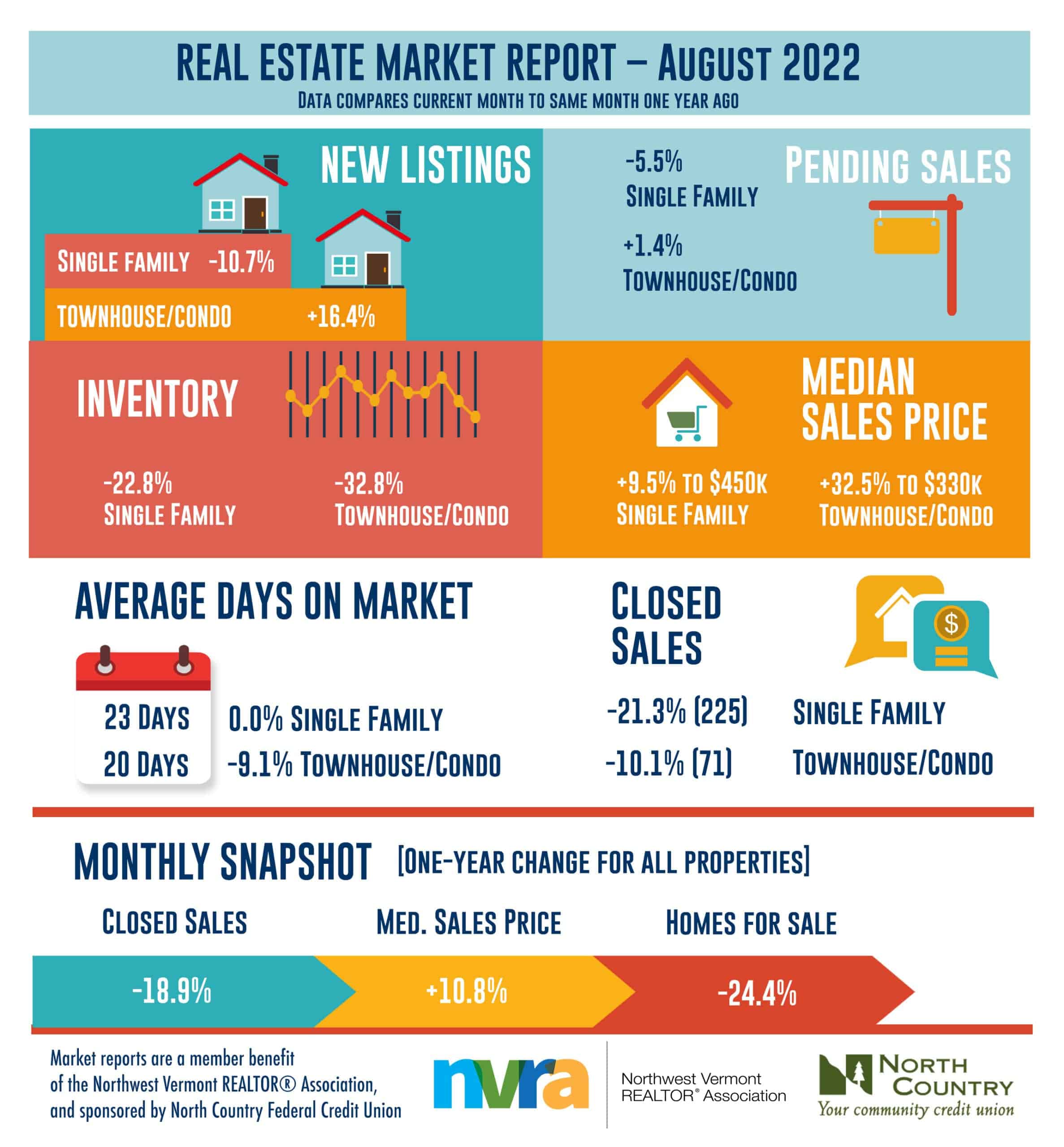
New Listings decreased 10.7 percent for single-family homes but increased 16.4 percent for townhouse-condo properties. Pending Sales decreased 5.5 percent for single-family homes but increased 1.4 percent for townhouse-condo properties. Inventory decreased 22.8 percent for single-family homes and 32.8 percent for townhouse-condo properties.

The Median Sales Price was up 9.5 percent to $450,000 for single-family homes and 32.5 percent to $330,000 for townhouse-condo properties. Days on Market remained flat for single-family homes but decreased 9.1 percent for townhouse- condo properties. Months Supply of Inventory decreased 5.9 percent for single- family homes and 30.0 percent for townhouse-condo properties.

Inflation, higher interest rates, and fears of a potential recession have taken a toll on buyers and sellers this summer, leading many people to stay on the sidelines to see what will happen with the market. But some experts, including NAR Chief Economist Lawrence Yun, believe the worst of inflation may be over. Although sales prices remain up from this time last year, price growth is expected to moderate in the months ahead as the market continues to shift in a more buyer-friendly direction.”

Do you have questions about the current market? We're here to help. Contact us today.

Vermont Real Estate Market Update: June 2022

Vermont Real Estate Market Update June 2022


Rising inflation, soaring home prices, and increased mortgage interest rates have combined to cause a slowdown in the U.S. housing market. To help quell inflation, which reached 8.6% as of last measure in May, the Federal Reserve raised interest rates by three quarters of a percentage point in June, the largest interest rate hike since 1994. Higher prices, coupled with 30-year fixed mortgage rates approaching 6%, have exacerbated affordability challenges and rapidly cooled demand, with home sales and mortgage applications falling sharply from a year ago.

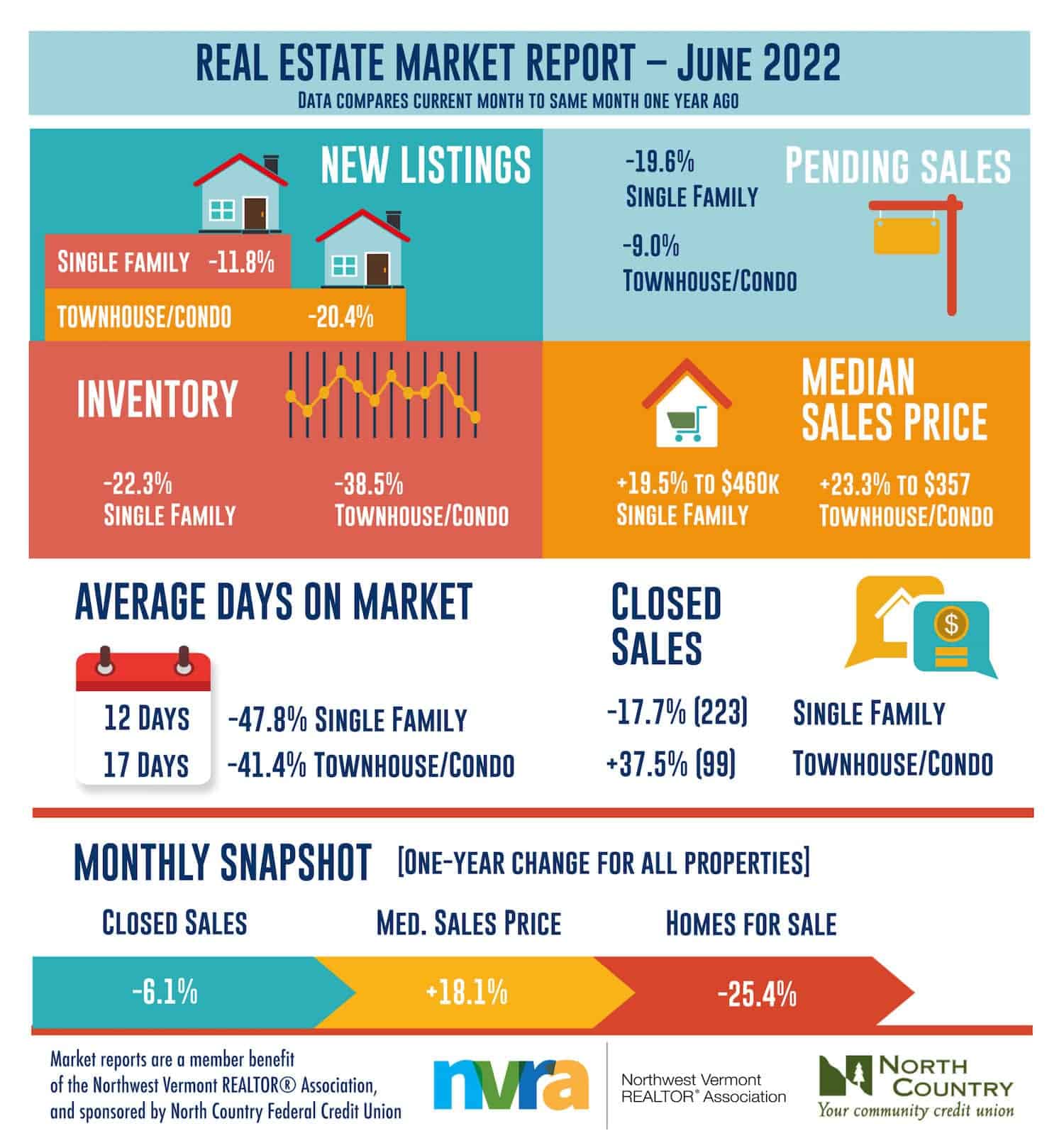
New Listings decreased 11.8 percent for single-family homes and 20.4 percent for townhouse-condo properties. Pending Sales decreased 19.6 percent for single-family homes and 9.0 percent for townhouse-condo properties. Inventory decreased 22.3 percent for single-family homes and 38.5 percent for townhouse-condo properties.

The Median Sales Price was up 19.5 percent to $460,000 for single-family homes and 23.3 percent to $357,555 for townhouse-condo properties. Days on Market decreased 47.8 percent for single-family homes and 41.4 percent for townhouse-condo properties. Months Supply of Inventory decreased 12.5 percent for single-family homes and 33.3 percent for townhouse-condo properties.

With monthly mortgage payments up more than 50% compared to this time last year, the rising costs of homeownership have sidelined many prospective buyers. Nationally, the median sales price of existing homes recently exceeded $400,000 for the first time ever, a 15% increase from the same period a year ago, according to the National Association of REALTORS®. As existing home sales continue to soften nationwide, housing supply is slowly improving, with inventory up for the second straight month. In time, price growth is expected to moderate as supply grows; for now, however, inventory remains low, and buyers are feeling the squeeze of higher prices all around.

Do you have questions about the current market? We're here to help. Contact us today.
Vermont Market Update: February 2022

Vermont Housing Market Update: February 2022

The U.S. real estate market remains hot ahead of the spring selling season, with existing home sales up 6.7% as of last measure, according to the National Association of REALTORS®. Experts attribute the growth in sales to an uptick in mortgage interest rates, as buyers rushed to lock down their home purchases before rates move higher. Mortgage rates have increased almost a full percentage point since December, with the average 30-year fixed-rate mortgage briefly exceeding 4% in February, the highest level since May 2019.

New Listings decreased 4.6 percent for single-family homes and 5.4 percent for townhouse-condo properties. Pending Sales decreased 17.3 percent for single family homes but increased 3.6 percent for townhouse-condo properties.

Inventory decreased 42.7 percent for single-family homes and 54.5 percent for townhouse-condo properties.

The Median Sales Price was up 12.5 percent to $365,500 for single-family homes and 24.0 percent to $310,000 for townhouse-condo properties. Days on Market decreased 35.7 percent for single-family homes and 66.7 percent for townhouse-condo properties. Months Supply of Inventory decreased 41.7 percent for single-family homes and 57.1 percent for townhouse-condo properties.

Inventory was at an all-time low of 860,000 as February began, down 17% from a year ago and equivalent to 1.6 months supply. According to Lawrence Yun, Chief Economist at the National Association of REALTORS®, much of the current housing supply is concentrated at the upper end of the market, where inventory is increasing, while homes priced at the lower end of the market are quickly disappearing, leaving many first-time buyers behind.

The shortage of homes is boosting demand even further, and with bidding wars common in many markets, it’s no surprise sales prices continue to soar.

Wondering what your home is worth in your current market? Get a free market analysis today! 

Vermont Market Update: January 2022

Northwest Vermont Market Update January 2022 Infographic


The 2022 real estate market begins where 2021 left off, in which existing home sales reached their highest level since 2006, with the National Association of REALTORS® reporting sales were up 8.5% compared to the previous year as homebuyers rushed to take advantage of historically low mortgage rates. Home sales would’ve been even greater were it not for soaring sales prices and a shortage of homes for sale in many markets, forcing a multitude of buyers to temporarily put their home purchase plans on hold.

New Listings decreased 27.4 percent for single-family homes and 32.4 percent for townhouse-condo properties. Pending Sales decreased 7.9 percent for single-family homes and 32.6 percent for townhouse-condo properties. Inventory decreased 50.9 percent for single-family homes and 45.8 percent for townhouse-condo properties. The Median Sales Price was up 16.5 percent to $395,000 for single-family homes and 17.5 percent to $275,750 for townhouse-condo properties. Days on Market decreased 16.7 percent for single-family homes and 57.7 percent for townhouse-condo properties. Months Supply of Inventory decreased 50.0 percent for single-family homes and 42.9 percent for townhouse-condo properties.

For many buyers, 2022 marks a new opportunity to make their home purchase dreams a reality. But it won’t be without its challenges. Inventory of existing homes was at 910,000 at the start of the new year, the lowest level recorded since 1999, according to the National Association of REALTORS®, and competition remains fierce. Affordability continues to decline, as inflation, soaring sales prices, and surging mortgage interest rates reduce purchasing power. The sudden increase in rates and home prices means buyers are paying significantly more per month compared to this time last year, which may cause sales to slow as more buyers become priced out of the market.

Wondering what your home is worth in your current market? Get a free market analysis today! 

6-10 of 13 Posts
Recommended Searches