Islands Realty

July Market Review: More Homes for Sale, Buyers See Growing Opportunities in Northwest Vermont

July 2025 Vermont Real Estate Market Update

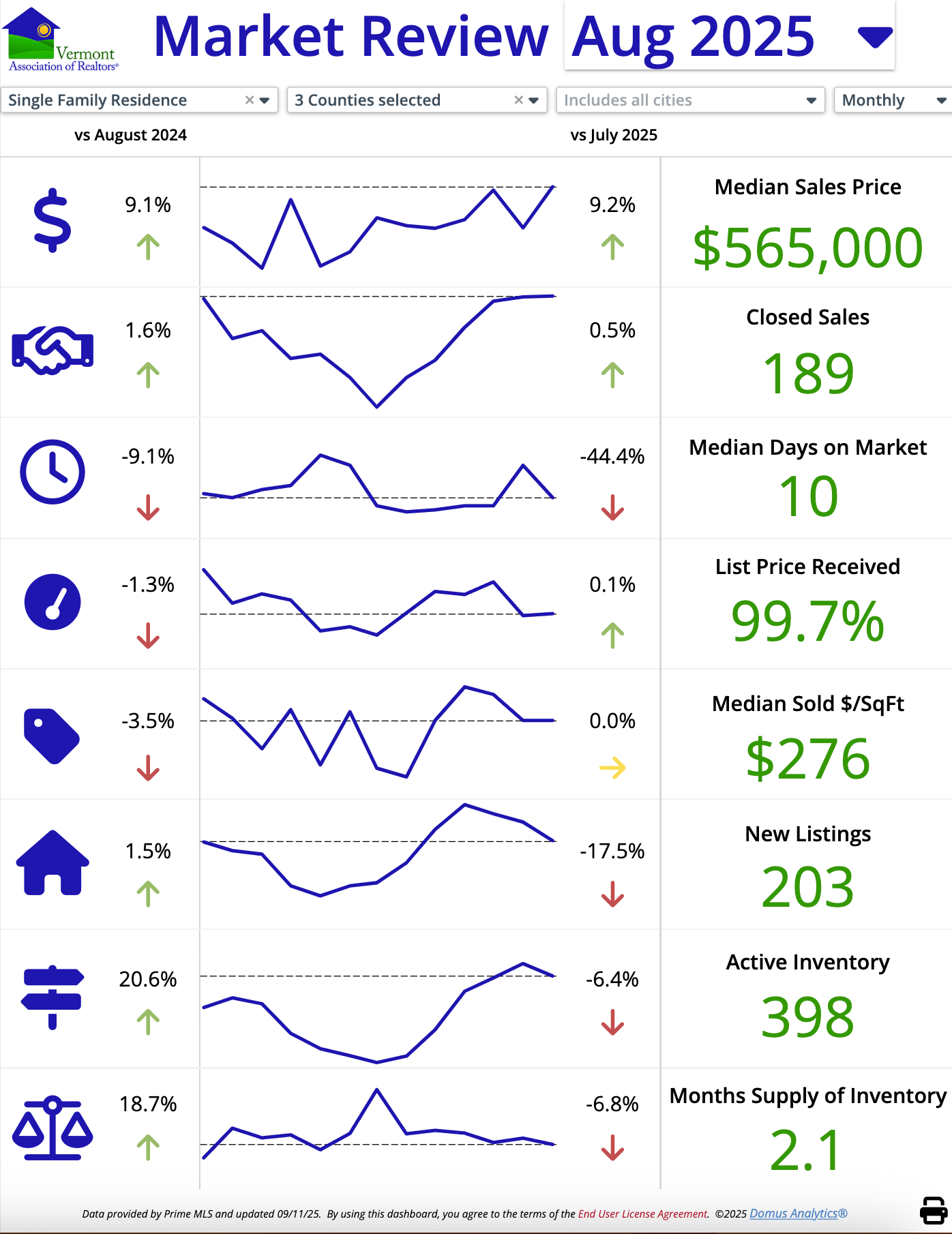
In July 2025, the Northwest Vermont real estate market showed mixed trends across Grand Isle, Chittenden, and Franklin counties. The median sales price dipped to $517,450, down 4.2% from last year, while closed sales rose 9.3% with 188 homes sold. Homes are taking longer to sell, with the median days on market jumping to 18, a 63.6% increase compared to last year. Sellers are still receiving near full price, with homes selling at 99.6% of list price, while buyers are seeing more options as new listings rose 22.4% and active inventory grew 39.3%. If you’re thinking about buying or selling, now is the time to understand how these shifts affect your goals—contact us today for a personalized market analysis.

What to Budget for When Buying a Home

Buying a home is one of the biggest financial decisions you’ll make, but the listing price is only part of the equation. There are several costs you should prepare for when purchasing a home. From inspections to insurance, here are some key expenses to plan for so you’re financially prepared when buying a property in Vermont. 

1. Pre-sale Inspections 

Depending on how many pre-sale inspections you choose to do, these costs typically fall on the buyer. The price of a standard home inspection is based on the size of the home and can range between $400 - $700. You also may need to budget for additional inspections and tests, such as radon, water, chimney, and septic. While not mandatory, these extra evaluations are often requested by buyers to ensure the home and its systems are in good condition before finalizing the sale. This can save you from costly surprises down the road or prevent you from purchasing a property outside of your means.

2. Homeowners Insurance

Home insurance is legally required if you're financing your home with a mortgage. Lenders want to make sure the property is protected, and as a buyer, you should too! The cost of homeowners insurance can vary based on location, coverage level, and home value, but it’s a recurring cost to factor into your monthly budget.

3. Appraisal and Loan Origination Fees

If you're taking out a mortgage, your lender will require a professional appraisal to confirm the home’s market value. This ensures the property is a sound investment. Appraisal fees are paid upfront by the buyer, usually before final loan approval. 

You’ll also encounter a loan origination fee, which is a charge from your lender for processing the loan application. This fee varies but is typically 0.5% to 1% of the loan amount. If you’re getting financing, it is recommended to research two or three different lenders to learn more about their offerings and fees.

4. Saving for a Down Payment

Some loan programs let you buy a home with as little as 0% to 5% down. However, if you’re able to put down more, this can help you qualify for a better interest rate and lower monthly payments. It also shows sellers that you're financially prepared and serious about buying. A common goal is to save 20% of the home’s price, but any amount above the minimum can be helpful. 

Need help with your down payment? The Vermont Housing Finance Agency (VHFA) offers specific programs and down payment assistance programs through local lenders. Visit their website to learn more and see if you qualify. 

5. Earnest Money Deposit

When you make an offer on a property, you’ll include an earnest money deposit. Think of it as a way to show the seller you’re committed to the purchase. This deposit is typically 1% to 3% of the price of the property, but it can be higher if the home is in high demand or if you want your offer to stand out.

6. Closing Costs

In addition to your down payment, you’ll need to budget for closing costs—the various fees and expenses due when finalizing the purchase of your home. These typically range from 2% to 7% of the purchase price, depending on the location, property, and lender. These fees are handled at the closing table and are often paid for out of the transaction.

Here’s a breakdown of common closing costs:

  • Attorney Fees – Legal services to help prepare and review documents.
  • Title Insurance – Protects you and your lender if there’s an issue with the property’s ownership history.
  • Property Transfer Tax – A state tax paid when a home changes ownership.
  • Tax Prebate Repayment – In Vermont, if the seller received a property tax prebate, the buyer may be responsible for reimbursing a portion.
  • Recording Fees – Charged by the town or city to officially record the sale.
  • Prepaid Interest – Covers the interest on your loan from the closing date until the end of the month.
  • Escrow Deposits – Upfront payments for future property taxes and homeowners insurance.
  • Pro-rated Property Taxes & Utilities – You may need to reimburse the seller for their portion of property taxes or utilities already paid for the year.

Helpful Tip: It’s often less expensive to close at the end of the month, since you’ll pay less prepaid interest upfront.

7. Buyer's Agent Commission (If Not Covered by the Seller)

While it’s typical for the seller to cover the cost of the buyer’s agent in a real estate transaction, that is not always the case. If the seller doesn’t offer this, it may become an out-of-pocket expense for the buyer, so it's important to clarify with your agent how the commission will be paid early on, before looking at properties.

6. Moving Expenses and New Furnishings

The cost of moving, whether you’re hiring professional movers or doing it yourself, can add up quickly. You may also need to budget for new furniture, appliances, window treatments, or even utility setup fees. It’s easy to overspend during this exciting transition, so build a cushion into your budget to avoid stretching yourself too thin.

Buying a home is exciting, but it’s important to leave enough financial breathing room for life after closing. By planning ahead for these lesser-known expenses, you can avoid surprises and start your next chapter on solid financial ground. To learn more about the costs of buying a home, connect with a Realtor.

Where to Watch the Sunset in Northwest Vermont

sunset spots in vermont

Living in Northwest Vermont, we’re incredibly lucky to have some of the most stunning sunset views practically in our own backyard. Here are our top five favorite spots to catch those breathtaking Vermont sunsets:


1. Overlook Park | South Burlington
 A perfect stop on your way home, Overlook Park offers sweeping views of Lake Champlain and the Adirondacks. With plenty of parking and easy access, it’s a favorite spot for locals to pause and soak in the scenery as the sun sets.


2. Island Line Trail | Colchester & South Hero
For a truly epic experience, walk or bike the Island Line Trail. With parking access points in both Colchester and South Hero, it’s an easy starting point no matter where you're coming from. One side of the trail offers sweeping views of the Adirondacks and Lake Champlain glowing with sunset colors, while the other side features the Green Mountains lit up with the golden hour light. 


3. Burlington Waterfront | Burlington
Grab a classic Vermont creemee from one of the many nearby ice cream stands, then stroll along the lively Burlington Waterfront. The mix of vibrant town energy and peaceful lake views makes for a very memorable sunset.


4. Isle La Motte Beach | Isle La Motte
If you want a quieter, more relaxed sunset experience, Isle La Motte Beach, located on the west shore of the island across from St. Anne’s Shrine, is the spot. Pack a picnic, enjoy a swim, or just unwind in this peaceful small-town setting as the sun goes down.


5. Mount Philo State Park | Charlotte
For an elevated perspective, head to Mount Philo State Park. You can drive or hike to the summit to take in expansive views of the lake and surrounding mountains. The panoramic sunset vistas here are truly worth the effort!


6. Shelburne Farms | Shelburne
Walk the beautiful grounds, take in views of the lake, rolling hills, and the historic architecture. Or, head to the Inn for a drink on the porch and watch the sun dip below the Adirondacks for a truly serene evening.


Whether you’re working out to catch the views or simply stopping to soak it in after a long day, Vermont offers amazing scenery and nature close to home, one of the best parts about living here.
 

A Self-Guided Tour of the Champlain Islands' History

The Champlain Islands boast a rich and fascinating history, shaped by the enduring legacies of Indigenous peoples, European settlers, and even past presidents. This vibrant past is illuminated by numerous roadside markers scattered throughout Grand Isle County and along the shores of Lake Champlain. Embark on this scenic route to not only enjoy the breathtaking island landscapes but also to discover intriguing historical insights.

Vermont Historic Marker Samuel de Champlain, South Hero, VT

Samuel de Champlain - South Hero, VT

Location: Just off U.S.Route 2, South Hero, at the visitor pull-off.

As you enter the Islands, a marker on the causeway commemorates Samuel de Champlain, the first European to discover Lake Champlain and its islands. You’ll find the plaque at a parking area on the causeway, a narrow road with stunning lake and mountain views. Here, you can learn about the first two centuries after de Champlain's arrival and capture a panoramic photo with the stunning lake as your backdrop. Down the road, Sandbar State Park offers opportunities for swimming, kayaking, lakeside relaxation, and a playground.


First South Hero Settlement - South Hero, VT

Location: At the intersection of U.S. Route 2 and South Street  on the left.

Moving north into the village of South Hero, a marker is located on the land where the Allen’s family tavern once stood. Read the plaque to learn where the “Hero” Islands get their name. While the tavern is no longer there, check out the marketplace and stop by the local snack bar, Seb’s, to experience the spirit of Vermont!

Vermont Historic Marker, Hyde Log Cabin, Grand Isle, VT

Hyde Log Cabin - Grand Isle, VT

Location: U.S. Route 2, just north of Grand Isle Elementary

Next, step into the past at the Hyde Log Cabin located just past Grand Isle Elementary. One of the earliest buildings on the island, this log cabin showcases the family environment of the time and how the revolutionary soldier, Jedediah Hyde Jr, built a house to sustain all weather conditions. Additionally, with a schoolhouse next door, you can also observe the changes in classroom life from the 1800s to the present day.  


Grand Isle Courthouse - North Hero, VT

Location: 3677 Route 2, North Hero , VT

In the lakeside village of North Hero overlooking city bay, you will find the second courthouse built in Vermont, the Grand Isle Courthouse. Built in 1824 with locally quarried limestone, this is one of Vermont’s oldest surviving courthouses. At the time, it also held a jailhouse and church showing the town's success and stability. Located in the quaint village of North Hero, the courthouse is near great spots to have lunch or a snack along the way, with beautiful views of the lake. 


historic fisk farm vermont

President Roosevelt’s Visit - Isle La Motte, VT

Location: 3849 West Shore Rd , Isle La Motte, VT

Isle La Motte, with its sandy beaches and fossil reef, is also the site of a (vice) presidential visit. In 1901, Franklin D. Roosevelt visited the current Lieutenant Governor to speak at the Vermont Fish & Game League about the importance of preserving the environment. While in Vermont, he learned that President McKinley had been shot and left to be with him. Nearby, you can also visit Fisk Farm and Fisk Quarry Reserve to learn more about the history of Isle La Motte and see beautiful views of the lake! 


Sweet’s Ferry - Isle La Motte, VT

Location: 1250 West Shore Rd , Isle La Motte, VT

Continuing north and moving a few years closer to the present day, Sweet’s Ferry was home to the first gas-powered ferry on Lake Champlain, which took travelers back and forth from New York and Isle La Motte, including Henry Ford, Thomas Edison, and Franklin Roosevelt. Check out where the boat docked on Lake Champlain and enjoy the lake views!


saint annes shrine vermont

French Fort of Ste. Anne - Isle La Motte, VT

Location: 138 West Shore Road, Isle La Motte, VT, near Ste. Anne’s Shrine

An important part of colonial history on the Islands is the Fort of Ste. Anne. This fort was a military base and chapel for French soldiers, providing protection from the Iroquois. In 1666, the first church mass in Vermont was held here on Isle La Motte. Over one hundred years later, a chapel and shrine were built. Saint Anne’s Shrine is still open today and offers church services, retreats, special events, a beautiful outdoor chapel, and a monument of Samuel de Champlain.


The Bohannan Site, Indigenous Peoples Village - Alburgh, VT

Location: Intersection of Route 78 and E. Alburgh Road , Alburgh, VT

The French were not the first people to discover Lake Champlain, as Indigenous Peoples were living there long before European arrival. Traveling north into the village of Alburgh, there is a historic marker to commemorate where Iroquoian-speaking Indigenous Peoples lived before European settlement. The marker describes what an archaeological team discovered, such as tools and decorative jars, giving an insight into their life at the time. 


Samuel de Champlain - Alburgh, VT

Location: 70 North Main Street, Alburgh , VT

Coming back to the Island's European founder, stop by the Vermont Welcome Center in Alburgh to learn more about de Champlain and other impactful people in the Island’s origin. Additionally, you can find information on activities and events in Vermont at the Welcome Center.


The Champlain Islands offer more than just their natural beauty; there is a unique history with markers throughout the county to tell the story of the region’s vibrant past. Discover the rich history and picturesque scenery of the Champlain Islands by exploring these significant sites. These stops offer a deeper understanding of the region's past and events that shaped this unique corner of Vermont. Explore these and other statewide historic markers throughout the state.

Comments

  1. No comments. Be the first to comment.

June 2025 Vermont Real Estate Market Update: Prices Rise and Homes Sell Fast

June 2025 Real Estate Market Update

As of June 2025, the Northwest Vermont real estate market remains active and competitive. Year-to-date, the median sales price for single-family homes in Grand Isle, Chittenden, and Franklin counties rose to $524,000—an increase of 4.8% compared to this time last year. Closed sales climbed 10.2%, signaling strong buyer demand, while sellers received an average of 100.1% of their list price. Homes are selling quickly, with a median of just 8 days on the market, and new listings are up 16.8%, offering more options for buyers. With prices trending upward and properties moving fast, it's important to work with a local real estate expert who understands the nuances of your neighborhood. Contact us today to get a custom market analysis and expert guidance tailored to your real estate goals.

46-50 of 341 Posts
Recommended Searches